

因为这样的事,在Scala中可以没有内置break语句,但如果正在运行的Scala2.8,那么还有一个办法使用break语句。当break语句在循环中遇到循环立即终止,程序控制继续下一个循环语句后面的。
语法:
break语句的语法是有点不同寻常,但它的工作原理:
// import following package
import scala.util.control._

// create a Breaks object as follows
val loop = new Breaks;

// Keep the loop inside breakable as follows
loop.breakable{
    // Loop will go here
    for(...){
       ....
       // Break will go here
       loop.break;
   }
}
流程图:
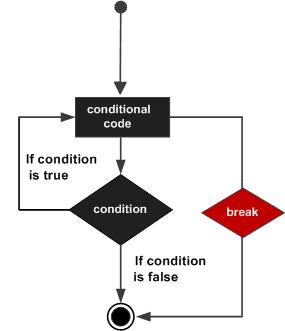
示例:
import scala.util.control._

object Test {
   def main(args: Array[String]) {
      var a = 0;
      val numList = List(1,2,3,4,5,6,7,8,9,10);

      val loop = new Breaks;
      loop.breakable {
         for( a <- numList){
            println( "Value of a: " + a );
            if( a == 4 ){
               loop.break;
            }
         }
      }
      println( "After the loop" );
   }
}
当上述代码被编译和执行时,它产生了以下结果:
C:/>scalac Test.scala
C:/>scala Test
Value of a: 1
Value of a: 2
Value of a: 3
Value of a: 4
After the loop

C:/>
打断嵌套循环:
使用嵌套循环打破现有循环。所以,如果有使用break嵌套循环,那么下面的方式来进行:
示例:
import scala.util.control._

object Test {
   def main(args: Array[String]) {
      var a = 0;
      var b = 0;
      val numList1 = List(1,2,3,4,5);
      val numList2 = List(11,12,13);

      val outer = new Breaks;
      val inner = new Breaks;

      outer.breakable {
         for( a <- numList1){
            println( "Value of a: " + a );
            inner.breakable {
               for( b <- numList2){
                  println( "Value of b: " + b );
                  if( b == 12 ){
                     inner.break;
                  }
               }
            } // inner breakable
         }
      } // outer breakable.
   }
}
当上述代码被编译和执行时,它产生了以下结果:
C:/>scalac Test.scala
C:/>scala Test
Value of a: 1
Value of b: 11
Value of b: 12
Value of a: 2
Value of b: 11
Value of b: 12
Value of a: 3
Value of b: 11
Value of b: 12
Value of a: 4
Value of b: 11
Value of b: 12
Value of a: 5
Value of b: 11
Value of b: 12

C:/>
我要分享文章
最近发布 »
- windows IIS6服务器全站301永久重定向设置方法
- thinkPHP实现签到功能的方法
- 详解java代码中init method和destroy method的三种使用方式
- Python获取文件所在目录和文件名的方法
- linux sudo命令详解
- 用于判断用户注册时,密码强度的JS代码
- Django-Rest-Framework 权限管理源码浅析(小结)
- 服务器 安全检查要点[星外提供]
- python 导入数据及作图的实现
- JS正则替换去空格的方法
- 微信小程序promsie.all和promise顺序执行
- Android实现渐变色的圆弧虚线效果
- Python中文编码那些事
- JS跨域请求外部服务器的资源
- asp的程序能实现伪静态化的方法
- 基于Vue.js与WordPress Rest API构建单页应用详解
- 修改MaxFieldLength与MaxRequestBytes彻底解决Request Too Long的问题
- sql字符串函数大全和使用方法示例